NicaNotes
October 29, 2026
By Stephen Sefton
[Stephen Sefton is a naturalized Nicaraguan citizen, a writer and community worker who has been based in Nicaragua since 1994. Besides coordinating the web outlet Tortilla con Sal since 2008, he has supported community education and health programs in and around Estelí, where he lives, since 1996.This article was first published by Tortilla con Sal on Oct. 25, 2026.]

Coleen Littlejohn died today October 25th after a long illness. She leaves a huge gap for all those who knew, loved and respected her talented and tireless hard work for and passionate commitment to the Sandinista People’s Revolution and for Nicaragua, which for most of us are one and the same, as they were for Coleen.
Everyone lucky enough to have known her will have their own recollection of Coleen’s impressive and influential record of enthusiastic work for and defense of Nicaragua’s Sandinista Revolution from the 1980s up until the very last weeks of her life.
For my part, I came to know Coleen quite late in life, really as a result of the failed coup attempt of 2018, during and after which she played a central role in mobilizing international solidarity in North America and Europe against the ferocious psychological warfare offensive of Western governments and their vast media, academic and NGO machinery of deceit and disinformation.
Others will recall Coleen’s leading role in solidarity with Nicaragua’s Sandinista Revolution during the 1980s, from the weekly demonstrations outside the US Embassy to arranging important material support, intensive media work and constant lobbying of both the US and allied governments.
Later during the 1990s, apart from her political solidarity work, Coleen was very well known for her successful work developing grass roots community organizations to accompany Nicaragua’s impoverished rural and urban families in overcoming the endless adversity of life under corrupt, neoliberal governments. Coleen’s work made it possible for thousands of low-income families in Nicaragua to cope better than they might otherwise have done with the hardships caused by the campaign of privatization and public spending cuts imposed under the oppressive tutelage of US and European ruling elites.
Coleen went on to take up posts in international financial institutions, working both in Africa and Latin America, which enabled her to gain extremely useful experience and insight into the thinking and workings of organizations like the World Bank which she later put to good use to improve strategy initiatives with her compañeras and compañeros in solidarity with Nicaragua.
For me, one striking aspect in my conversations with Coleen was her humanity in that she was always very clear and steadfast in supporting the FSLN government led by Daniel Ortega and Rosario Murillo despite having sincere personal friendships with ex-Sandinistas who later decided to work one way or another against the FSLN, aligning themselves with US and allied imperialist governments.
Coleen’s Catholic faith was a decisive factor motivating and sustaining her solidarity with Nicaragua’s Sandinista Revolution and her forthright criticism of the contradictions and hypocrisies of Catholic Church institutions, including the Jesuit order’s abuse of its universities, from one of which, Le Moyne College, she was an alumna, for political attacks on Nicaragua’s government.

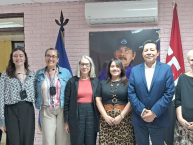
Coleen (far right) accompanies a National Lawyers Guild delegation to Nicaragua at a meeting with the Minister of Education and Presidential Advisor on Education earlier this year.
It is no exaggeration to say that losing Coleen is truly an irreparable loss for Nicaragua. Few individuals have made such a great positive difference to the lives of so many thousands of Nicaragua’s families over the last five decades. No one had her range of experience, knowledge and contacts across North America and Europe, nor her capacity to mobilize them in an effective, coherent way in support of what is now the most successful, strategic political project in Latin America and the Caribbean, the Sandinista People’s Revolution, something Coleen recognized with unrivalled clarity.
In 2024 Nicaragua’s Copresident Compañera Rosario Murillo said of Coleen, “From 1980 here, always to the fore, compañera Coleen Littlejohn, whom we recognize for all her efforts accompanying us, and her constant dissemination of our realities and defense of our Truths.”
As always with the loss of much loved and highly respected individuals, we can celebrate the great gifts Coleen Littlejohn gave us all her life and take joy and inspiration from and in all her great achievements, for her unfailing kindness and humanity and for all she has taught us thanks to her great heart and her exceptional, incisive intelligence.
Hasta Siempre Coleen!
Tributes to Coleen from NicaNotes Writers and Contributors
From Roger Harris
Originally from the snow country of upstate New York, Coleen Littlejohn chose to make Nicaragua her home and to support its Sandinista Revolution. Coleen’s Nicaraguan husband died in a plane crash in Cuba that some suspected had been caused by US sabotage. A naturalized citizen, she lived in Nicaragua since 1980, raising her son there. Her grandchildren were the joy of her life. In 2023, Coleen presented a professional case study titled “A Different Pandemic Strategy: Nicaragua Example” at an international conference on the effects of COVID-19 restrictions in low- and middle-income countries held at King’s College in London. She continued to organize international solidarity delegations to Nicaragua, even after she had undergone repeated cancer treatments. In March 2025, Coleen hosted a delegation from Veterans for Peace. Her home was always a welcoming place for international visitors and locals alike, whom she treated with characteristic warmth. And everything she did was infused with grace. Her kindness and generosity were extraordinary.
From Barbara Larcom
I first met Coleen Littlejohn briefly, probably in early 1991, when she served as the accomplished interpreter for our Casa Baltimore/Limay delegation during a Managua meeting. Our paths did not cross again until the summer of 2018, as the attempted coup was ending in Nicaragua. During that period, some of us began sharing more accurate, often firsthand, information about Nicaragua events via articles and social media. Coleen was an integral part of our growing network. We decided to do an ebook with individuals authoring different chapters by topic. In April 2019, many of us gathered at her home to finalize our coauthoring plans and the title of our book, Live from Nicaragua: Uprising or Coup? Coleen was a member of Nicaragua Solidarity Coalition’s coordinating committee since 2023. Last year she facilitated the coalition’s closer relationship with the European Solidarity Committee. She was a featured speaker in several Nicaragua Webinars, most recently in October 2025. I am grateful to have known Coleen, and I’m grateful for her many contributions while she was with us. Thank you, Coleen Littlejohn! Presente! Presente! Presente!
From Jill Clark-Golub
As part of her efforts to enlighten people on the left about the true nature of the 2018 coup attempt, Coleen worked with the United National Anti-War Coalition to be sure that Nicaragua was included in UNAC’s 2020 conference. This led to Camilo Mejía giving a very moving speech at the opening session, and inclusion of Nicaragua in a panel on regime change. Coleen also played a key role in organizing the Nicaragua hearing of the “International People’s Tribunal on US Imperialism” on June 3, 2023, which gave a valuable history of US intervention in Nicaragua. The recording can be found here: https://internationalpeopletribunal.wordpress.com/videos-transcripts/
From Nan McCurdy
Coleen was a very kind and inclusive person with hundreds of good friends. She was always willing to try to help someone out. She loved the Sandinista Revolution and all of the advances for the people. She was good at explaining this to people and always said “they need to come here and see for themselves.” She hosted hundreds of people in her home so that they could do this. Like so many – I miss her already.
Katherine Hoyt
Instead of writing something myself, I have found a paragraph that my colleague Chuck Kaufman wrote about Coleen in 2019 as an intro to a chapter in the ebook Uprising or Coup. It gives us more of Coleen’s background as a development expert making use of her Master’s Degree in economics from John’s Hopkins University.
I first met Coleen Littlejohn in 1987 on my first coffee picking delegation. She was the Nicaragua Network in-country coordinator and handled our logistics and introduction to Nicaragua Libre. Coleen came to Nicaragua from Chile in the first week of January, 1980 to help Catholic Relief Services’ (CRS) transition from emergency to post war development financing. From 1982-1984 she served as CRS representative for the International Reconstruction Fund until she moved to Atlanta to work with the solidarity movement for Nicaragua, coordinated with the anti-apartheid movement. She also worked with Haitian refugees. Coleen returned to Nicaragua in early 1986 to open the office of the Nicaragua Network which she headed until late 1988 when she founded a local NGO, CAPRI. She later worked for Save the Children Canada in Nicaragua and Toronto until 2004 when she went to work for the World Bank in Nicaragua and subsequently in Liberia. Her final 18 months with the World Bank were spent in Washington, DC until her December, 2015 retirement and return to live in Nicaragua.
Briefs
By Nan McCurdy
The Rubén Darío Order of Cultural Independence awarded posthumously to Coleen Littlejohn
The Government of Nicaragua will honor the memory of Coleen Littlejohn with the posthumous awarding of the Rubén Darío Order of Cultural Independence, in recognition of her legacy, during a solemn ceremony to be held October 28 at Pueblo Presidente University, announced Co-President the Republic, Rosario Murillo. (El 19, 27, October 2026)
Proposed 2027 General Budget Presented to National Assembly
Central Bank President Ovidio Reyes presented the proposed General Budget of the Republic for 2027 to the plenary session of the National Assembly on October 21. He noted that the national economy is moving forward steadily after posting 4.1% growth in the first half of 2026, with GDP growth projected to be around 3% for 2027, accompanied by low and stable inflation of approximately 3%. One of the most notable aspects of the budget is the generation of an overall surplus of US$734.9 million (equivalent to 2.8% of GDP). With this result, the country has achieved seven consecutive years of fiscal surpluses, demonstrating responsible, orderly public management focused on social welfare. These public savings have made it possible to reduce public debt from 68% to 48% of GDP without sacrificing social investment, financing public works with the country’s own resources and strengthening financial sovereignty.
The budget totals US$5.3 billion in revenue and US$4.57 billion in expenditures structured around fundamental pillars of human development. 64.7% of total spending is allocated to programs and projects aimed at combating poverty and reducing inequalities, representing 11.5% of GDP. The health and education sectors account for 66.8% of social spending, ensuring free medical care, medications, school infrastructure, salaries, and scholarships. Subsidies aimed at protecting the real income of the most vulnerable families remain in place, covering urban public transportation, electricity, drinking water, and fuel. A total of US$1.39 billion (81% financed with domestic resources) is allocated, prioritizing flagship projects such as the modernization of Punta Huete International Airport, the Port of Bluefields, the road resurfacing program, hospitals, and sports complexes. (La Primerisima, 22 October 2026)
Loan for US$170 Million from CABEI to Improve Drinking Water in four Cities
The government of Nicaragua has paved the way for new financing of $170 million from the Central American Bank for Economic Integration (CABEI) to modernize and expand drinking water systems. The implementing agency will be the Nicaraguan Water and Sanitation Company (ENACAL). ENACAL’s Executive President, Ervin Barreda, told INFORME PASTRÁN that the program will benefit nearly 46,000 families in Estelí, Masatepe, Boaco, and Somoto. In Estelí, some 27,000 families will be served, in a city that has grown rapidly in all directions. In Masatepe, 5,326 families will benefit; in Boaco, between 6,000 and 7,000; and the remainder will be in Somoto. The project includes the installation of approximately 200 kilometers of piping, reinforcements, and network upgrades, as well as well drilling. (Informe Pastran, 22 October 2026)
Government Begins Awarding 29,000 Scholarships to Future Professionals
The Sandinista government began awarding 29,000 scholarships on October 22 through the 12 public universities and the training centers of the National Institute of Technology and Technical Education (INATEC). “I want to reiterate that we are awarding 29,000 scholarships—the ‘Pueblo Presidente’ scholarships—to an equal number of students so they can develop their talents in the degree programs of their choice at the 12 ‘Pueblo Presidente’ universities,” said Co-President Rosario Murillo. The scholarship program aims to support students and their families in continuing their studies, ensuring access to a comprehensive education in the various professional and technical fields of their choice.
In addition, INATEC organized the National Congress on Innovation, Science, and Technology, a forum for academic exchange and research that saw the active participation of more than 2,000 teachers and students from across the country. (La Primerisima, 22 October 2026)
Investments in the Electricity Sector Exceed US$5.2 Billion
Nicaragua is moving toward 99.77% electricity coverage and consolidating a generation mix in which renewable sources account for about 70%, supported by the incorporation of lithium-ion battery storage systems that will provide stability to the grid in the face of climate variability, Energy and Mines Minister Salvador Mansell told INFORME PASTRÁN. The national demand has undergone a structural shift. Previously, it was concentrated during nighttime hours; today, it remains high during the day and reaches peaks exceeding 800 MW, driven by growth in residential, commercial, and agribusiness sectors. In this context, the diversification of the energy mix including solar, wind, hydroelectric, geothermal, biomass, and backup thermal power has made it possible to meet demand without interruptions, even in a year marked by atypical weather patterns. The minister highlighted that the country already has its first 30 MW of lithium-ion batteries whose containers are currently being connected at substations, and that the second phase of 70 MW will be installed between 2027 and 2028, for a total of 100 MW, with an investment exceeding US$115 million in the first phase this year and another US$80 million for the second phase in 2027. These batteries kick in automatically in response to fluctuations in wind or solar radiation, or when power plants go offline, and can supply energy for five hours allowing time to restore power generation. Nicaragua advanced with these investments while other countries in the region were announcing emergency measures in response to similar energy crises. Cumulative investment in the electric grid has already reached US$5.2 billion. Between 2025 and 2026, more than 220 MW of new capacity has been added or is under construction, with investments totaling nearly US$283 million, and an additional 179 MW is projected for 2027 at a cost of US$220 million. (Informe Pastran, 22 October 2026)
Services for Treating Urinary Tract Diseases to Be Expanded
The Sandinista government, through the Ministry of Health, will deliver eight pieces of modern medical equipment to the hospitals in Estelí and Managua to expand specialized services for treating kidney stones and other urinary tract diseases, as well as to perform ear, nose, and throat surgeries. (Investment: US$1.5 million). This equipment consists of two laser lithotripters, two pediatric endourology towers, two otolaryngology towers, and two surgical microscopes. (La Primerisima, 26 October 2026)