NicaNotes
October 8, 2026
PETITION: We Demand an End to U.S. Intervention in Nicaragua!
Organizations and individuals: Please sign on to this petition demanding an end to U.S. intervention in Nicaragua sponsored by the Nicaragua Solidarity Coalition.
(The Nicaragua Solidarity Coalition is an international coalition of organizations and individuals in solidarity with Nicaragua, supporting its sovereignty and affirming its achievements.)
Nicaragua has long been a target for U.S. regime change and the attacks are escalating. Hostile U.S. rhetoric is increasing and sanctions are being tightened.
SIGN ON TO DEMAND AN END TO US INTEVENTION IN NICARAGUA!
A July 19th speech by President Daniel Ortega was deliberately misinterpreted to claim that, in Nicaragua, elections have been abolished. The lie has been spread through an orchestrated media campaign. The State Department now tacitly admits that elections will continue, but objects to constitutional measures aimed at protecting Nicaraguan voters from foreign meddling in their elections.
The Trump administration aims to bring Latin America and the Caribbean back under U.S. hegemony. Electoral coups and trade wars have brought right-wing governments into power and threatened Brazil and Mexico; Venezuela suffered an outright invasion and the kidnapping of the constitutional head-of-state; Cuba suffers an ever-tightening, genocidal blockade.
Now, right-wing members of Congress press the administration to ensure that “after Cuba, Nicaragua is next.”
Two Congressional hearings in September and a meeting of foreign ministers of the Organization of American States have endorsed this threat. Already, the National Endowment for Democracy has released new funding to achieve regime change. Some Nicaraguan opposition groups are even calling for armed intervention.
Meanwhile, for two months, consultative meetings have been held across Nicaragua, with ordinary people, business leaders, opposition parties, churches and many other groups, to discuss constitutional reforms. Nicaraguan elections will not be open to any candidate who has received foreign funding, has conspired to overthrow the government, or has called for sanctions or military intervention against their own country.
Such provisions are found in the U.S. constitution and in laws of most western nations.
Nicaraguans have every reason to protect their democracy. World Bank analysis shows that poverty fell by almost half and extreme poverty by 60% in just eleven years. This is due to massive progress in health, education, reductions in inequality, and Nicaragua’s success in reducing the violence linked to drug trafficking and organized crime that plagues neighboring countries.
The Trump administration wants to reverse these achievements and bring Nicaragua into its “Shield of the Americas” club. It seeks a right-wing government that cuts social spending, sidelines labor and environmental protections in favor of corporations, gives drug-trafficking networks the keys to government, and vastly increases military spending. Given the tendency of Latin America’s new right-wing governments to align with Israel, such a government in Nicaragua could also be expected to abandon the country’s historic case before the International Court of Justice charging Germany with complicity in Israel’s genocide against the Palestinian people.
It is a stark choice. The Nicaraguan people, not the U.S. Congress or State Department, should make it.
We demand that Nicaragua’s sovereignty be respected. We call on the U.S. Congress and administration to abandon their colonialist attitude and instead allow the Nicaraguan people, and all the peoples of Latin America and the Caribbean, to choose their own governments and live in peace.
SIGN ON TO DEMAND AN END TO US INTEVENTION IN NICARAGUA!
***********************
The US Constitution Prohibits Those “Engaged in Insurrection” from Public Office – So Will Nicaragua’s!
By John Perry
[Writer John Perry lives in Masaya, Nicaragua, and publishes in several outlets. This article has been published in Countercurrents, Black Agenda Report, Global Research, Tortilla con Sal, Resumen Latinoamericano, and Internationalist 360.]

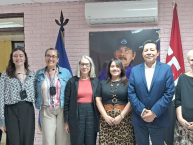
In dozens of meetings across the country – like the one pictured above in Estelí – ordinary Nicaraguans have supported key reforms to protect their electoral process. Photo: Radio Nicaragua.
Last week I was at a local neighborhood meeting in the Nicaraguan city of Masaya. More than a hundred people had come to hear a report from a doctor from the local health center and from a teacher at the technical college where the meeting was being held. We learnt about the attention being given to pregnant women (currently 11 pregnancies in the area), the mobile health clinic that would be arriving soon and new agricultural courses starting at the college, which opened only three years ago.
Then there was a political discussion about changes to the electoral system and the latest threats from Washington. Such neighborhood meetings represent Nicaragua’s “lived democracy.”
However, just eight years ago, for three months in mid-2018, it would have been impossible for my neighbors to meet or – in many cases – even leave our homes. The highway in front of what is now the technical college was full of roadblocks, erected and controlled by armed opposition thugs.
In this very street, a police officer was killed in an opposition attack. Masaya, a key focus of that year’s coup attempt, is peaceful once more. No one in the community – even those who don’t support the Sandinista government – wants a return to conflict.
That’s why, in dozens of meetings across the country – like the one pictured above in Estelí – ordinary Nicaraguans have supported key reforms to protect our electoral process. National Assembly President Gustavo Porras, speaking in Estelí, said that “the elections are going to be the same as always,” but with the important qualification that they will not be open to anyone who has received foreign funding, has conspired to overthrow the government, or has called for sanctions or military intervention against their own country.
The nationwide consultations have included Nicaragua’s 15 political parties, whose rights to take part on an equal basis in presidential, regional and local elections are protected. Six of these parties had presidential candidates in the 2021 elections and others contested local elections.
There is nothing unusual about Nicaragua’s reforms. Practically all western countries have strict laws preventing foreign interference in elections. Not only is this the case in the US, but its constitution even specifically debars people from holding public office if they have “engaged in insurrection or rebellion” against the state or given “aid or comfort to the enemies thereof.”
Nicaragua is simply trying to protect its electoral process from foreign interference – overwhelmingly sponsored by Washington – in its politics. Such interference has been going on for decades and is intensifying.
The National Endowment for Democracy’s president, Damon Wilson, bragged to a House committee in February that his organization is funding media in Nicaragua with an eye to undermining its Sandinista government. NED funding comes through the State Department. Commenting on recent developments, Wilson claimed: “The Ortega-Murillo regime may seek to abolish elections, but it cannot abolish the Nicaraguan people’s desire for democracy. We will stand with them until that right is restored.”
There is no longer anything clandestine about such interference; Trump brags about it. At the Shield of the Americas summit in Miami on 7 March, he told Latin American leaders: “They are losing and they beg me for an endorsement. I give them an endorsement. They win by 30 points.”
Of particular significance to Nicaragua was his blatant interference in the elections in neighboring Honduras when, largely thanks to Trump, his favored candidate narrowly won after a highly questionable count. The New York Times concludes that “President Trump has become an electoral kingmaker in Latin America.”
Trump’s blatant interference continues unabated. Francisco Dominguez argues that in Brazil’s forthcoming polls, the Trump administration is overtly and intensely interfering in favor of the far-right candidate, Flavio Bolsonaro. The Times describes Trump’s influence as “looming” over Brazil’s elections. The LA Times calls it a fight by Trump, together with Marco Rubio, “to control the hemisphere.”
Free and fair elections are now at risk across the Americas – a threat US voters know well as Trump uses “the levers of presidential power” to sway the mid-terms.
If a huge country like Brazil has to fight to protect its electoral integrity, how much more at risk is a small country like Nicaragua, with a population just 3% of Brazil’s? Next door Honduras shows how a progressive government can be replaced by extreme neoliberalism if Trump intervenes.
As I write this, US Senate hearings are taking place and a meeting of Latin American foreign ministers has been called, both to discuss the “crisis” in Nicaragua. The problem, of course, is not that the country has “abolished” elections, as Rubio has claimed and corporate media have repeated. Rather, Nicaragua wants – as far as it can – to shield itself against Washington’s interference in its politics. For Rubio, this means that its government has “abandoned even the pretense of popular consent.” In reality, it is precisely such popular consent that has returned the Sandinista government to office in every election over the past two decades.
Briefs
By Nan McCurdy
Proposed 2027 Budget Remains Committed to Reducing Poverty
The draft Revenue and Expenditure Budget for 2027, which the Presidency will submit to the Nicaragua’s National Assembly in the middle of this month is based on the country’s solid and sustained economic growth and maintains public investment in infrastructure and social investment aimed at combating poverty. The bill preserves subsidies for drinking water rates, electricity, urban transportation, housing, and retirees, among other areas designed to protect household consumption.
With this design, the 2027 budget represents the continuation of a state policy that combines economic dynamism with spending directed toward productive infrastructure projects and poverty reduction, without cutting the transfers that alleviate the cost of basic services. The budget bill is submitted to the National Assembly on October 15 of each year. It is debated, analyzed, and reviewed in November and December, and must be approved no later than December 15. (Informe Pastran, 1 October 2026)
Mulukukú Bridge Strengthens Connectivity Between Pacific and Caribbean
The Sandinista Government, through the Ministry of Transportation and Infrastructure (MTI) and with the support of the Japan International Cooperation Agency (JICA), has successfully completed construction of the Japan-Nicaragua Friendship Bridge, which crosses over the Tuma River in the municipality of Mulukukú, in the North Caribbean Coast Autonomous Region. This strategic project, 176 meters long and located on the Río Blanco-Siuna highway, stands as one of the country’s most important road infrastructure projects, strengthening land connectivity between the Pacific Coast, the country’s central region, and the Northern Caribbean. The imposing structure directly benefits more than 54,000 residents, facilitating the safe and continuous transport of livestock, agricultural, and mining products to national and international markets. It will also stimulate trade, expand tourism, and promote swift and timely access to health, education, cultural, and sports services. See photos: https://radiolaprimerisima.com/2026/10/01/nuevo-puente-de-mulukuku-fortalece-conectividad-entre-el-pacifico-y-caribe-norte/ (La Primerisima, 2 October 2026)
MARENA: 10 Million Seedlings for National Reforestation
The Ministry of the Environment and Natural Resources (MARENA) has produced more than 10 million tree seedlings this year for reforestation projects, which is nearly 90% of its yearly goal. Regional nurseries throughout the country receive daily delivery to support planting efforts, the agency’s head, Javier Gutiérrez, reported. (La Primerisima, 1 October 2026)
Third Phase of the Cancer Center in Managua Advances
Construction of the third phase of the Dr. Juan Ignacio Gutiérrez Cancer Center in Managua is 47% finished, and it is expected to be completed in May of 2027. This center has been providing care to families since March 2025, with the first and second phases already operational, offering outpatient care, chemotherapy, and patient housing. Services provided cover the following specialties: medical oncology, surgical oncology, gynecologic oncology, breast oncology, internal medicine, anesthesiology, pain management, psychological counseling, nutritional consultations, and chemotherapy administration. The center also performs endoscopies, ultrasounds, electrocardiograms, echocardiograms, and biopsies to ensure timely diagnosis. Located at kilometer 15 of the Carretera Sur in Managua, this center is equipped with state-of-the-art technology and is staffed by specialists in various fields of oncology. (La Primerisima, 5 October 2026)
SINAPRED Assists Families Affected by River Flooding
Nicaragua’s National System for Disaster Prevention, Mitigation, and Response (SINAPRED), along with local committees (COMUPRED) and community brigades have been mobilized to provide relief and support in response to the damage caused by the heavy rains recorded in the early hours of October 3 in the departments of Jinotega and Rivas. According to an early report, in the municipality of El Cuá (Jinotega), as a result of overflowing of the El Cuá River and the Los Aparejos Creek, 22 homes were temporarily flooded. In addition, partial damage was reported to a bridge and the local power grid, where technical teams are already working to restore services. In the municipality of Santa María de Pantasma (Jinotega), the overflowing of waterways caused flooding in various locations. In the Limones Uno community, six homes were flooded and 15 meters of rural road were damaged; in the Malecón Cuatro community, six homes were flooded; and in the El Venado community, 12 homes were flooded and a pedestrian bridge was destroyed. Meanwhile, in the municipality of Tola (Rivas), four homes in the La Ceiba community were flooded. See photos: https://radiolaprimerisima.com/2026/10/02/sinapred-atienden-a-failias-afectadas-por-desbordamientos-de-rios/ (La Primerisima, 3 October 2026)
Families from Masaya Participate in Consultation on Election Reforms
On October 4, families from Masaya, Nindirí, Tisma, and La Concepción participated in the consultation on election reforms organized by the National Assembly at the El Coyotepe Fortress in Masaya. The Special Constitutional Commission, chaired by the president of the National Assembly, Dr. Gustavo Porras, presented the seven fundamental pillars of the reforms to the residents. One of the reforms is that terms for co-presidents, elected officials, and military and police leadership are extended from six to seven years. The measures also protect national sovereignty and prevent foreign political interference.
Representatives from different sectors of society expressed their opinions regarding the amendments to the Constitution, which were approved during the first legislative session. On this occasion, the consultation was held in honor of General Benjamín Zeledón, a National Hero who gave his life in the fight against U.S. interventionism. (La Primerisima, 4 October 2026)
Bismarck Martínez Program to Hand Over 450 Homes in the Last Quarter of 2026
Co-President Rosario Murillo announced on October 6 the housing delivery schedule for the Bismarck Martínez Program for the last quarter of the year. The first 100 homes will be handed over to their new owners in October, followed by a second batch of 50 homes on November 18 and another 100 on November 25. In December, deliveries will continue on the 16th with an additional 100 homes, culminating before the end of the year with a final batch of 100 housing units, benefiting a total of 450 new families across the country. Murillo emphasized that this social and humanitarian project, launched in memory of the Hero of Peace, Bismarck Martínez, reflects the effort and hard work of the families who have achieved the goal of owning their own homes. See photo: https://radiolaprimerisima.com/2026/10/06/programa-bismarck-martinez-entregara-450-viviendas-en-ultimo-trimestre-del-ano/ (La Primerisima, 6 October 2026)
Nicaragua Withdraws from PARLACEN
Co-President Rosario Murillo reported that “on Saturday the 3rd [of October], we respectfully notified the leadership of the Central American Parliament of the immediate termination of our membership agreement with that body, which we regret to say has failed to fulfill its objectives and functions for the benefit of families throughout the region”.…“We are left watching, as the children’s riddle says, “Cartas van, cartas vienen, pasan por el mar y no se detienen.” [Letters go, letters come, they pass on the sea and they do not stop.] Unfortunately, those letters that come and go do not represent what we all need and want: agreements to improve the lives of our peoples, our families, everywhere, and our countries. From here, as always, we send our warmest and most heartfelt greetings and embraces to the peoples, families, and states of our Central America, always trusting in God that we will have a more harmonious and promising future. In this process, in accordance with our sovereignty, and with the respect due to the designated authorities of that organization and the parliaments that remain as members, we … move forward,” she said. [El Salvador left PARLACEN last year; Costa Rica and Belize aren’t members so that leaves Guatemala, Honduras, Panama and Dominican Republic. As regards the Central American Court, Nicaragua withdrew from the Court last year. It is now defunct since Honduras, El Salvador and Guatemala all abandoned it this year.] (Informe Pastran, 5 October 2026)
500 Young People to Participate in 10th Edition of Hackathon Nicaragua
A total of 500 young Nicaraguans, organized into 100 multidisciplinary teams, will gather October 7 and 8 at the Olof Palme Convention Center to take part in the final stage of the 10th edition of Hackathon Nicaragua 2026, the country’s most important technology marathon. Event organizers, coordinated by the National Institute of Technology (INATEC) in conjunction with the Ministry of Education, the National Council of Universities, and the Network of Young Communicators, selected these 100 teams from among more than 2,000 registered participants. The working methodology is based on the creation of mobile applications and web platforms designed to address challenges in priority sectors such as health, education, tourism, agricultural development, and creative cities.
Each group is composed of members with complementary skill sets, including programmers, communicators, and graphic designers, who are mentored by professionals from the national technology sector. At the end of the two intensive days of work, a panel of judges will evaluate the presentations and award a total of nine prizes. Many of the applications developed in previous editions are currently in use at public institutions, private enterprises, and as tools for the educational inclusion of people with disabilities. (La Primerisima, 6 October 2026)