By Dirk Groenenberg
(Dirk Groenenberg is a chemical-free farmer from Rusagonis, New Brunswick, Canada, and a member of solidarity groups such as the Maritimes-Guatemala Breaking the Silence Network and Fredericton Palestine Solidarity. Here we combine two articles by Goenenberg that were published by NB Media Coop on July 29, 2024 and Sept. 13, 2024.)

The author pauses for a rest in Palestine Park in Managua.
I recently went back to Nicaragua, the Central American country where I lived 35 years ago. I wanted to revisit this country to participate in the forty-fifth anniversary of this country’s revolution as part of a political delegation and to visit farmers and areas where I used to work.
The main reason I applied to work in Nicaragua in the eighties was because there was a job opening to work with a New Brunswick-initiated seed potato project and I had experience growing seed potatoes. I had heard of, and was interested in, the Revolution that had taken place 10 years earlier in 1979.
When I arrived in 1989, I had a hard time learning Spanish and I was eager to get to work. I didn’t get a lot of orientation on the history of the Revolution; it may have been assumed I knew all about it as most cooperants had been involved in solidarity work. Although I learned much about the Revolution while working there, and since then, the places we visited and the presentations given this time in 2024 were largely new to me.
Some history
The Somoza dictatorship that was deposed by the Sandinista Revolution in 1979 was a brutal one. U.S. President Franklin D. Roosevelt in the 1930s famously said of the first dictator in the dynasty that he was: “a son of a bitch but our son of a bitch.” The U.S. supported the dictatorship’s family until the latest one was deposed in 1979.
Before the revolution, the Somozas and their cronies owned 75 per cent of cultivated land and many industries in Nicaragua. If they wanted more land or businesses, they demanded it and killed anyone opposing them.
The Sandinista National Liberation Front (FSLN) was formed in 1961. The FSLN embarked on a clandestine fight to get the country back from the dictatorship. The Sandinista Revolution, as it was called, triumphed in 1979, putting an end to more than 40 years of dictatorship.
At the Casa Benjamin Linder, the guest house where I am staying, I talked to a fellow named Omar who is employed there. Omar has a young family. He told me about life in his parents’ time during the Somoza dictatorship. It was obvious that there was a lot of corruption, with projects started but not finished. Money would disappear; highways were built for only a few kilometres; hospitals and schools were never finished or were badly maintained. Citizens felt very unsafe; people didn’t venture out in the evening for fear of Somoza’s infamous Guardia Nacional. They terrorized neighbourhoods by gunning down people at random.
After the revolution, in 1979, there was a general sense of relief and freedom, but it didn’t last long. In 1990, the FSLN lost the elections because the population of Nicaragua was tired of losing so many young people in the fight against the U.S.-funded Contras.
The FSLN defeat led to a series of neoliberal governments that were in power from 1990 until 2007. Many services in health, education, water, and so on were privatized and became unaffordable for low-income families.
With the Sandinistas back in power since 2007, health care is free, offering very advanced procedures, and education is free, including university. The hotel employee, Omar, is very happy with the opportunities this all gives his family, and others like him.
Nicaragua is also much ahead in developing a non-fossil fuel-based electricity supply. According to the government, 77 per cent of the country’s electricity is from renewable resources, 23 per cent from fossil fuels. However, the country is very vulnerable to the effects of the climate crisis because of the increased frequency of hurricanes, flooding and droughts.
There is less migration from Nicaragua to the U.S. at the present time, although I have seen advertisements for migration with promises of many high-paying jobs. The Nicaraguans I’ve spoken with seem generally quite satisfied with life here. The U.S. is trying to entice people to leave so they can blame migration on a “repressive regime.” Some migration occurs through Nicaragua, of course: a few days ago, a West Asian group stayed here in my hotel on their way to the US.
From Nicaragua to Palestine
Nicaragua made headlines earlier this year when it took Germany to the International Court of Justice for violating the Genocide Convention by continuing to supply arms to Israel during its current war on Gaza.
The FSLN first made contact with the Palestine Liberation Organization (PLO) in 1966, two years after the PLO was formed. The Sandinista government of Nicaragua officially recognized Palestine as a nation in 1988.
However, the relationship between Nicaraguan and Palestinian liberation movements goes back long before that. The man who inspired the FSLN, Augusto Sandino, was the leader of an army that forced the U.S. Marines to leave Nicaragua in 1933. A Colombian-born Palestinian named Ghadeer Abu Sneineh joined Sandino but had to flee Nicaragua after Sandino was assassinated in 1934. Two years later, in 1936, Ghadeer joined a major uprising in Palestine.
Another important figure was Patricio Arguello Ryan. Arguello was born in the U.S. to a Nicaraguan father and an American mother. They moved in and out of Nicaragua depending on the threat of the Somoza dictatorship. Arguello returned to Nicaragua in 1968 and was involved with the FSLN and did educational work for them. In 1970, he went to Jordan for militant training with Palestinians and he met Leila Khaled. Arguello and Khaled famously attempted to hijack El Al flight number 219. The attempt failed and he was killed by Israeli forces on the plane.
Khaled is currently in Nicaragua to celebrate the 45th anniversary of the Sandinista revolution. (See more below.)
On July 19, the International Court of Justice (ICJ) ruled that the Israeli presence in the Occupied Palestinian Territories is unlawful and directed states to not provide aid or assistance towards maintaining this unlawful situation. True to Sandinista ideals of fighting for the liberation of the oppressed, Nicaragua did not need an international court ruling to treat Israel’s war on Gaza as unlawful and side with Palestine.
July 2024 in Nicaragua
Because I arrived in Managua a few days early, I took part in one day of a delegation hosted by a rural workers association called the Asociación de Trabajadores del Campo. We heard several presentations on the developments in agriculture in different parts of the country and had an interesting educational tour of Managua.
My delegation started on July 13 with an orientation at the bed and breakfast where we were staying, called the Casa Benjamin Linder. It was named after an American engineer who came to Nicaragua in the early 1980s and worked on micro-hydro projects to supply rural communities with electricity. Linder was murdered by the U.S.-funded Contras, along with two co-workers.
The first day, we visited a Museum of the Revolution in Ciudad Sandino near Managua. The museum tells the history of colonialism, first by the Spanish, then by the U.S. with filibuster president William Walker. In the last century there were numerous incursions by U.S. marines and U.S.-imposed leaders, culminating with the Somoza dynasty (1936-1979), the last of whom fled during the last days of the Revolution.
We also visited the Ruben Dario Cultural Centre. Dario is Nicaragua’s national poet, although I remember that in the eighties he was remembered as a stodgy middle-class poet revered by the reactionary upper-classes. More recently his revolutionary and anti-oppression writing and thinking has been revived. At the Centre, we saw painting and dance classes being held, all part of the free education system.
We then visited a park where the Somoza dictatorship used to dispose of dead and tortured bodies. People knew to look there for missing friends and family as these “dumping ravines” were well known.
On July 14, we were invited to a mass at a Christian Base Community and to a Liberation Theology meeting and saw that it was a very inclusive and accepting community. In the earlier years of the Revolution, Liberation Theology was tolerated by the Catholic Church, not so now.
After that, we went to the Augusto Sandino house/museum near Granada. As noted above, Sandino was the Nicaraguan general who ousted the U.S. marines. He was assassinated by Anastasio Somoza who was then installed by the U.S. as Nicaraguan president.
The next day, we visited a non-profit medical clinic, the Nueva Vida clinic, run by the U.S.-based NGO Center for Development in Central America in Ciudad Sandino. The clinic was started during the neoliberal government’s time (1990-2006) when health care was too expensive for poor people to afford. The clinic provides care and medicines at very affordable rates.
In the afternoon, we had a meeting with labour union leaders. Many are government legislators so they represent workers from within the government. In Nicaragua, education —including university— and health care are free. Social spending in 2022 was 0.53 per cent of the country’s budget.
On July 17, we visited a rural village and an aquaponics farm. The farmer raises tilapia fish in tanks, sells the market size fish, and sells or gives away smaller fish. She had aquatic plants growing with the fish in the tanks and used the fish manure on vegetable beds. She also raised chickens and pigs. It was very impressive.

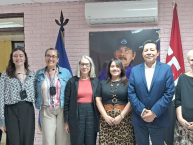
Groenenberg’s delegation met with a community potable water committee which maintains a water well, pumps and a storage tank high on a hill. The committee also collects water payments and hooks up customers. Photo shows the delegation members in front of their drilled water well, pump and tubing. Photo: Becca Renk
Later we visited a community potable water committee, in charge of maintaining a water well, pumps and a storage tank high on a hill. They also collect water payments and hook-up customers.
The next day, there were street parties organized all over Managua and other cities in the country, with bands playing and dancing. The whole population took part. The delegation was taken in various buses to different parts of Managua to join the street parties or vigils. On most of the street parties my group visited there were karaoke drag queen performances. Drag queens told members of our group that they were glad to live in a country where they could express their sexuality without fear of persecution.
In the morning, there was excitement in the air. At the celebration venue, we were seated in rows arranged so that from the air they looked heart-shaped with rays flowing out. On stage, dance performances were held and all the dignitaries were lined up: representatives from Russia and other East European countries, China, Vietnam and other Asian countries, many countries in Africa and South America, representatives from Nicaraguan military, police and civil organizations.
One of the favourites was clearly Leila Khaled from Palestine who gave an impassioned speech explaining her struggles and thanking Nicaragua for its support. Daniel Ortega’s speech was at the end. He laid out the gains of the revolution and the problems Nicaragua encounters from sanctions and blockades, mainly from the U.S.
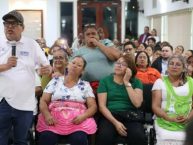
Within the crowd were many Sandinista youth as well as many other delegation participants from North America, Europe, Latin America and the Caribbean. They cheered the speakers, dance performers and broke out in spontaneous revolutionary songs.
* * * * *
Briefs
By Nan McCurdy
Second Section of the Sahsa-Puerto Cabezas Highway Up and Running
On October 9, the Nicaraguan Ministry of Transportation and Infrastructure (MTI), announced that it had finished the highway that will improve the lives of families of the Autonomous Region of the North Caribbean (RACCN). It is the second section of the Sahsa-Puerto Cabezas road with an extension of 28 kilometers. This new road, built with hydraulic concrete, will guarantee a safe, stable and uninterrupted connection between the Productive Development Poles of the North Caribbean Coast and the Central and Pacific regions. This is expected to significantly improve mobility in the area and foster the region’s economic and social development. The road’s construction resolves the historical isolation that affected the 123,638 residents of Bilwi, surrounding communities, and the Indigenous and Afro-descendant peoples who live there. The road is expected to boost tourism, trade and production, which will also contribute to improving the quality of life of the families of the Caribbean Coast. This road will facilitate access to services and markets, while strengthening the region’s road infrastructure. See photos: https://www.canal4.com.ni/mti-inaugurara-el-segundo-tramo-de-la-carretera-sahsa-puerto-cabezas/ (Canal 4, 7 October 2024)
Nationwide Meetings to Strengthen Education
From September 30 to October 4, in celebration of “Victorious October”, nearly 20,000 meetings, workshops and classroom visits were held throughout the country on education. Over 600,000 students, teachers, academic and administrative personnel from educational, technical and university centers exchanged ideas on the new National Education Strategy. Progress was made in the design of seven national programs related to teacher training, special inclusive training, artistic and cultural education, physical education and sports, science, research and innovation and educational technology. One example of the kind of encounters being carried out is one with women participants in the Zero Usury Program in the departments of Masaya, Rivas, Jinotega and Managua that will take place October 10. Among the aspects of the “New Strategy – Education for Life” are: Education in Values, Artistic and Cultural Education, History and National Identity, Environment and Nature, Effects of Climate Change, Physical and Sports Education, Inclusive Special Education, Science, Research and Innovation, Inclusion and Equity Classroom, Educational Quality, Teacher Training, Institutional Strengthening, and Infrastructure and Equipment. (La Primerisima, 4 October, 2024)
Creative Economy Model Highlighted at Brics+ Summit in Russia
During the BRICS+ 2024 International Fashion Summit, held in Moscow October 3-5, Camila Ortega Murillo, coordinator of the National Commission of Creative Economy of Nicaragua and General Director of Nicaragua Diseña, participated in a panel entitled “Creative Capital: Role of Creative Industries in Economic Development.” She stressed the importance of the Creative Economy as an engine for development to help countries grow, fostering creativity, innovation, promoting entrepreneurship and integrating the cultural values of communities. She said that in 2019 the National Commission for the Creative Economy was established, a platform through which the National Creative Nicaragua Program will be promoted; with the promotion of entrepreneurship innovation as fundamental. She emphasized the future of the creative industries in the region, the new points of attraction and the different platforms promoted by the government of Nicaragua such as EXPOPYME, Nicaragua Emprende, Hackathon Nicaragua and Nicaragua Diseña, platforms focused on supporting, developing and promoting the creative and innovative ideas of artists, designers, entrepreneurs, video game designers and other actors that are part of the creative industry in Nicaragua. “Nicaragua’s participation in the BRICS+ Summit reflects Nicaragua’s commitment to promoting international partnerships that strengthen its creative and cultural sector, while integrating them into global discussions on sustainability, innovation and inclusive development,” Ortega Murillo said. (La Primerisima, 4 October 2024)
Bluefields to Have a State-of-the-Art Baseball Stadium
In 2025 construction will begin on a new baseball stadium in the city of Bluefields identical to Masaya’s stadium. Bluefields has waited since the Somoza years for this stadium and the community is excited about the project. The executive director of the Nicaraguan Sports Institute, Marlon Torres, reported that there will be new stadiums both in Bluefields in the South Caribbean and in Bilwi in the North Caribbean. “We believe that there is a historical debt to these towns. Baseball entered Nicaragua more than 120 years ago through the Caribbean Coast, we believe that it is time for them to have the first-class infrastructures that we have in the Pacific,” stated Torres. (La Primerisima, 6 October 2024)
Great Advances in the Fight Against Breast Cancer
Breast cancer is the second type of cancer that most affects women in the country and diagnosis and treatment have increased. Dr. Andres Zamora of the Health Commission of the National Assembly, said that last year more than 4,500 people were diagnosed with some type of cancer. For prevention of breast cancer, the Ministry of Health has 44 mammographs nationwide. “The national cancer program aims to prevent and detect cancer in a timely manner and ensure effective treatment, so the country now has more specialized centers, linear accelerators for radiation and trained medical personnel,” said Zamora. The equipment for cancer detection has high costs; only a mammograph could cost more than US$120,000. Nevertheless, the government has as a priority free health care. A survey conducted by Radio La Primerísima confirmed that women are aware of the risk of breast cancer and know there is more access to specialized studies for prevention. “Since I was 40 years old, I have had a breast exam every year, because my doctor recommended it as a preventive measure, I also know about self-examination, which means examining your own breasts and if you notice something strange, go immediately to your doctor,” said one of the women consulted. Every October 19, World Breast Cancer Day is commemorated as an important date to raise awareness and the need for health systems to improve access to treatment and diagnosis. (La Primerisima, October 8, 2024)
Hundreds of Women Undergo Mammograms in Diriamba
The Ministry of Health (MINSA) took the mobile mammography clinic to the municipality of Diriamba, in Carazo, on Oct. 7 where hundreds of women received medical attention.
Dr. María Luisa Parrales, radiology specialist at the Diriamba Hospital said “I feel very lucky to work with this high-tech equipment that is benefiting women.” Dr. Parrales, who was diagnosed with stage three breast cancer a year ago, shared her experience with the attendees. “I have gone through 16 chemotherapies and a surgery in which both breasts were removed, followed by radiation. I am deeply grateful to the Ministry of Health, because throughout this disease I always had the necessary treatment. Now I am here to tell you that I will continue working to help all women to detect this disease in time,” she said. The doctor also stressed the importance of these mobile clinics reaching every corner of Nicaragua at no cost to patients. “The exams would be very expensive without free healthcare; and what one suffers when one has this disease is devastating both economically and emotionally. But in Nicaragua it is all free. The initiative of the Ministry of Health seeks to guarantee access to specialized medical services and contribute to the early detection of cancer. See photos: https://radiolaprimerisima.com/realizan-mamografias-a-centenares-de-mujeres-en-diriamba/ (La Primerisima, 7 October 2024)
Energy Self-Sufficiency for ENACAL with ENESOLAR
Water coverage is a fundamental issue for Nicaragua; and for this important issue there are several new projects, especially with the ENESOLAR plants (solar projects). Erving Barreda, executive president of ENACAL (Nicaragua’s water company) talked about the energy projects that seek to generate energy self-sufficiency for this company. He said, “ENESOLAR 3 strengthens a strategy of our government to improve the water service for our families. ENESOLAR 1 is under construction in the sector of San Isidro. ENESOLAR 2 in the sector of Malpaisillo has the support of CABEI (the Central America Bank for Economic Integration). And we are starting ENESOLAR 3 in the sector of Masaya.” Barreda also said that these first two plants will be in operation next year and ENESOLAR 3 is projected to be running in 2026. ENESOLAR 1 and 3 are supported by the Chinese company China Business CCCC and will have the ability to generate 200 megawatts an hour, contributing to security, energy efficiency and sustainable development.
He explained, “There is a commitment to ensure a constant water supply for families and for this, 100% electric energy is needed. One of the main costs incurred by the water company month after month is the consumption of electricity. Pumping water is one of the main consumers of electricity in the country. It represents sometimes up to 60% of our operating expenses. This large project includes a biogas plant in Managua, in the wastewater plant. And the whole complex, in full operation, would have the capacity to generate the energy demanded by ENACAL today; thus it would be self-sufficient in energy.” He went on to say, “We are going to reduce greenhouse gases and transform the electricity generation matrix, but we are also going to generate many jobs; and we will have a secure source of energy.” ENACAL is working with the Chinese company, CCCC, one of the largest companies in the world. Barreda stated that the plants will last more than 25 years; with the most advanced technology that currently exists. (El Digital 19, October 8, 2024)