NicaNotes
July 9, 2026
Return Venezuela’s Stolen Wealth for Full Quake Recovery
NicaNotes is happy to share the following sign-on petition on Venezuela initiated by Sanctions Kill/Americas Without Sanctions and encourages you and your organizations to sign on.
In the wake of devastating earthquakes, and for a full recovery, “It is time to return to Venezuela what rightfully belongs to Venezuela.” SanctionsKill/Americas Without Sanctions invites international solidarity activists and organizations to sign and share the following statement here.

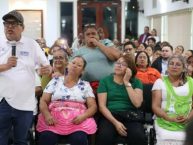
Thousands of Venezuelan civilians and government workers have been working around the clock to save people from the rubble after devastating earthquakes on June 24, 2026. Photo: NBC3.webp
The Statement
We extend our full solidarity and condolences to the Venezuelan people as they grapple with the human tragedy caused by the twin earthquakes of June 24, 2026. We applaud emergency aid to rescue those under the rubble and meet the needs of the living victims.
This natural disaster comes on top of the U.S. invasion and kidnapping of the president in January, several months of extrajudicial killings in Venezuela’s territorial waters, years of deadly U.S. sanctions, and the theft of Venezuela’s assets overseas.
In order to allow Venezuela to rebuild and recover from this disaster, we demand that the United States:
–Fully and permanently lift all sanctions on Venezuela;
–Return Venezuela’s oil revenues to the Venezuelan government;
–Unfreeze all of Venezuela’s overseas assets—including billions in gold and other currencies held at the Bank of England and elsewhere;
–Free President Nicolás Maduro and First Lady Cilia Flores from the U.S. jail where they are being illegally held as political prisoners; and
–Refrain from using disaster relief as an excuse for military occupation.
The U.S. government’s pretense of friendship to Venezuela rings hollow, after years of U.S. sanctions and military aggression have caused several tens of thousands of deaths. U.S. assistance for reconstruction will be paltry compared to the massive heist it has perpetrated against the country through assets theft and sanctions. What Venezuela needs for post-earthquake reconstruction is the return of the billions of dollars the U.S. government and its allies have stolen.
It is time to return to Venezuela what rightfully belongs to Venezuela.
____________________
Sign as an individual or an organization here. En español aquí.
Also, attend the Venezuela Solidarity Network webinar on July 3 (7pm Eastern / 4pm Pacific) to learn about the situation on the ground and the tasks for international solidarity. Register here.
Send a message to your US Representative in Congress urging them to advocate for the unfreezing of Venezuela’s assets and an end to all US sanctions against Venezuela!
Relief donations can be made through Code Pink here and/or Fundalatin by writing to fundalatin@gmail.com.

Briefs
By Nan McCurdy
International Reserves Increase
The Central Bank’s Gross International Reserves (GIR) increased by US$1.1 billion, reaching a record high of US$ 9.4 billion at the end of the quarter, equivalent to nine months of coverage for imports of goods and services, compared to 6.9 months in March 2025. As a result of this strong performance, the balance of payments recorded a current account surplus of US$939 million—more than double the US$ 362 million surplus in the first quarter of 2025—and a positive result in the financial account of US$776.1 million. (Informe Pastran, 3 July 2026)
Dignified Housing and Markets
In the first phase of the San Martín project under the Bismarck Martínez Housing Program in Managua, nearly 70 homes have already been built, with additional phases scheduled for the coming years. The central government provides the housing through INVUR (Nicaraguan Institute of Urban and Rural Housing) and the municipalities, while the beneficiaries contribute the land. In addition, construction of the new section of the Managua municipal market is now in its third phase; it is a modern two-story building that will replace the old, dilapidated infrastructure located in the city center. The new market will allow for better service to the public and producers. (Informe Pastran, 2 July 2026)
Nicaragua Participates in Farewell to Ayatollah Ali Khamenei
Co-President Rosario Murillo announced on July 2nd the arrival in Tehran of an official delegation to the Islamic Republic of Iran, which will participate in the state farewell ceremonies, burial, and funeral of Ayatollah Ali Khamenei planned for July 3rd. The Nicaraguan delegation is composed of Valdrack Jaentschke, Co-Minister of Foreign Affairs; the mayor of Managua, Reyna Rueda; Douglas Lara Bustamante, President of the National Union of Students of Nicaragua (UNEN); and Ramón Moncada Colindres, Nicaragua’s Ambassador to Iran. (Informe Pastran, 2 July 2026)
Drug Seizure of 132 Packages of Cocaine near El Viejo
In a July 2nd press release, the Nicaraguan Army’s Directorate of Public and Foreign Relations reported that, in compliance with its Containment Wall Strategy, the Naval Force and the General Pedro Altamirano Special Operations Command seized four sacks containing a total of 132 packages of cocaine. The seizure took place seven kilometers south of the community of Mechapa in the Department of Chinandega. The cocaine was being transported from south to north aboard a panga-type boat named “Jesucristo Viene Pronto” by three individuals, two of whom were detained and one of whom fled when an exchange of gunfire occurred. In addition, one AKM rifle and ammunition, as well as one outboard motor, were seized. The detainees, the drugs, the weapon, the ammunition, and the boat with its motor were handed over to the appropriate authorities. See photos: https://www.el19digital.com/articulos/ver/179012-incautacion-de-droga-al-narcotrafico (El 19, 2 July 2026)
Coastal Highway Gives Access to 62 Pacific Coast Beaches
The Sandinista government, through the Ministry of Transportation and Infrastructure, inaugurated the fifth section of the Coastal Highway on July 2—a 30-kilometer road connecting Tupilapa in the Department of Carazo with Masachapa in the Department of Managua. This opening marks a milestone in national development and stands out as the news story of the week due to its historic significance, fulfilling decades of hopes held by communities along the Pacific coast. It sets Nicaragua on a path toward a future of prosperity, integration, and sustainability. With this new section, a total of 119 kilometers has now been built in the first phase of the Costanera, which now extends from El Naranjo, on the border with Costa Rica, to Masachapa.
The project connects the departments of Rivas, Carazo, and Managua, facilitating access to 62 beaches on the South Pacific coast and benefiting more than 1.8 million Nicaraguans. During the inauguration ceremony, presided over by Transportation Minister Óscar Mojica, the multidimensional impact of this “route to prosperity” was highlighted. “The coastal highway improves conditions for domestic and foreign investment. With this new project by our Co-Presidents, Daniel and Rosario, we are moving forward alongside the Nicaraguan people in the strategy for sustainable human development and the common good,” Mojica stated. The Costanera Highway represents not only a step forward in road infrastructure but also a model for environmental conservation and protection. Its construction included 44 wildlife crossings—four of which are tunnels—the planting of 577,000 native trees, and 646,000 square meters of grass. In addition, 60 new bridges and culverts were completed, definitively resolving the long-standing problems of flooding and road closures caused by rivers overflowing in the area. (Informe Pastran, 3 July 2026)
Nicaragua Demands Respect for Cuba and an End to All Threats
Nicaragua’s representative to the United Nations General Assembly, Jaime Hermida, stated on July 7 that the economic blockade against Cuba represents an anachronistic, illegitimate, cruel, and inhumane policy that violates the founding principles of the multilateral organization. He urged the international community to block the imposition of these measures, which violate the right of small states to development and self-determination.
Despite attempts by the U.S. delegation to prevent discussion of the need to end the economic, commercial, and financial blockade imposed by the United States against Cuba, the debate received the support of 136 nations, with only nine votes against and 30 abstentions. Hermida stated that Nicaragua aligns itself with the statements made by the representatives of Uruguay (on behalf of the G77 plus China), Uganda (on behalf of the Non-Aligned Movement), and Eritrea (on behalf of the Group of Friends in Defense of the United Nations Charter).
The Nicaraguan representative noted that the international community has stated every year that this anachronistic, unjust, illegal, and inhumane policy constitutes a flagrant violation of the purposes and principles of the United Nations Charter, international law, and the right to development. He added that the blockade is an economic, energy, media, and political war imposed on the Cuban people, collective punishment against a dignified and heroic nation. The diplomat stated that by depriving the Cuban people of food, medicine, electricity, fuel, transportation, financing, and legitimate opportunities to exercise their right to development, the aim is to break the will of a people who, for more than six decades, have demonstrated to the world their high values of dignity.
Similarly, Nicaragua denounced the threats and the possibility of military aggression against Cuba. Ambassador Hermida said, “We reject any threat or use of force against the Republic of Cuba.” He said that Cuba does not threaten anyone. “Cuba saves lives, trains doctors, and shares science, culture, education, healthcare, and solidarity-based cooperation with the peoples of the Global South. Cuba has been, is, and will continue to be a moral, cultural, scientific, and solidarity-based power,” he noted.
“Any military action would have serious consequences for regional and international stability and would constitute a direct violation of the proclamation of Latin America and the Caribbean as a zone of peace which demands dialogue, cooperation, mutual respect, the peaceful resolution of disputes, and full recognition of the sovereign equality of all states,” Hermida stated. He called on the international community to act responsibly, to reject any escalation of aggression, and to defend the right of the peoples of Latin America and the Caribbean to live in peace, security, stability, and dignity. (La Primerisima, 7 July 2026)
Agreement Signed with Costa Rica to Combat Malaria
Deputy Minister of Health Dr. Carlos Sáenz announced the ratification on July 3rd of a binational agreement with Costa Rica intended to strengthen epidemiological surveillance and coordinate simultaneous public health actions in the border region to reduce the transmission of malaria. “In the spirit of good neighborliness demonstrated by our leadership—our Co-Presidents, Daniel and Rosario—we were directed to ratify this binational agreement to work toward the elimination of malaria and ensure long-term sustainability to prevent its recurrence,” the official noted. The initial agreement was signed on April 9, 2021. Dr. Sáenz stated that although climate change has caused a widespread increase in malaria across the Americas, Nicaragua’s health system is showing highly positive results.
He emphasized that the permanent public health policies implemented by Nicaragua have made it possible to reduce, from 2023 to the present, three-quarters of the total number of malaria cases recorded. This drastic decline is the result of a comprehensive implementation of the Family and Community Health Model, which includes intensive campaigns to eliminate breeding sites, clear overgrown vegetation, apply larvicides, and spray insecticides at critical transmission hotspots, accompanied by robust education and risk communication campaigns to prevent the disease. The official noted that one of the greatest pillars of this public health success is the active participation of more than 9,000 volunteer collaborators spread throughout the country, with a special emphasis on regions with the highest incidence, such as the Caribbean Coast, Las Minas, Central Zelaya, Río San Juan, and Alto Wangki. He explained that these volunteers operate from their own homes as community health posts, equipped by the Ministry of Health with kits and supplies for collecting “thick smear” samples, supplemented by rapid tests in the hardest-to-reach communities. This exemplary coordination between the Community Network, the health workers, and state institutions earned Nicaragua a prestigious international recognition and award from the World Health Organization (WHO), Sáenz stated. In the remaining malaria-free areas, the network maintains strict containment surveillance, he added. (La Primerisima, 7 July 2026) To read more about Nicaragua’s fight against malaria, click here.
Nicaragua Fastest Growing Country in 2026
Nicaragua is positioned as one of the fastest-growing economies in Central America for 2026. The Banco Central de Nicaragua (BCN) projects an annual economic growth between 3.5% and 4.5%. Here are the key drivers and realities of Nicaragua’s economic status:
- Official BCN Projections: The Banco Central de Nicaragua forecasts the GDP to reach approximately $24.2 billion, supported by increases in mining, construction, and trade.
- Remittance-Driven Economy: Independent monitors point out that much of the country’s economic activity and stability stems from the boom in family remittances. Fitch Ratings estimates these inflows now make up nearly 27% of the country’s GDP.
- Regional Ranking: Projections from the World Bank and International Monetary Fund (IMF) place Nicaragua’s economy as one of the most dynamic in Central America, though external pressures and sanctions remain.
In 2026, Nicaragua is outperforming the broader Latin American average and ranks among the top tier for economic growth within Central America. While the Latin America and Caribbean region as a whole is projected to grow by just 2.1%, Central America is averaging a stronger 3.6%. Nicaragua’s projected growth of 3.5% to 4.5% puts it at the front of this regional surge.
Key Differences in Nicaragua’s Economic Model
- The Debt Advantage: Nicaragua maintains a public debt ratio near 40% of its GDP. This is one of the lowest ratios in Central America, giving it better fiscal stability than highly indebted neighbors like El Salvador or Costa Rica.
- Macroeconomic Paradox: Unlike Costa Rica or Panama, which rely on high levels of Foreign Direct Investment (FDI) and multinational corporations, Nicaragua’s growth is heavily internal and diaspora-driven. Record-high remittances fuel domestic spending, compensating for lower investor confidence due to political isolation.
Links to sources of information:
https://www.worldometers.info/es/pib/pib-nicaragua/#google_vignette
https://openknowledge.worldbank.org/entities/publication/43f0d5df-af73-4b7c-9e37-671b43ded0a6
https://www.imf.org/en/countries/nic
https://www.centralamericaeconomicreview.com/economic-articles/nicaragua-assessment-2026
https://www.worldbank.org/ext/en/country/nicaragua
https://www.worldeconomics.com/GDP/Nicaragua.aspx
https://www.investmentmonitor.ai/features/investors-guide-to-central-america/?cf-view