By David Escobar (La versión en español sigue al inglés)

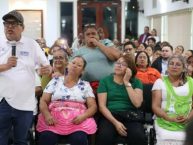
Demonstrations in Cali, Colombia, against the genocide of the Palestinian people. Oct 2/2025. Photo by David Escobar.
Colombia’s President Gustavo Petro has been one of most outspoken world leaders calling for an end to the war in Gaza. Towards that end, he has hosted an international conference on the issue and called for a multinational force to stop the still-ongoing genocide by Israel. In late September, while participating in sessions of the United Nations, Petro attended a Palestine solidarity rally outside the UN, and called for a “world salvation army, whose first task is to liberate Palestine. That is why, from here in New York, I ask all soldiers in the United States Army not to point their rifles at humanity. Disobey Trump’s order! Obey the order of humanity!” The White House responded by revoking Petro’s visa. Meanwhile, the US continues to disregard international law by providing weapons and other forms of support for ethnic cleansing in Gaza. In this article, Colombian journalist David Escobar responds to an article by Daniel Coronell, of Noticias de Univisión criticizing President Petro.
The column “Unforgettable”, published by colombian journalist Daniel Coronell in October 2025, aims to question the international behavior of President Gustavo Petro, whom he holds responsible for provoking the verbal attacks of Donald Trump—who falsely accused him of being a drug trafficker—as a result of his participation in a demonstration in New York against the genocide of the Palestinian people in Gaza. According to Coronell, “the vertigo of feeling like a world leader, without actually being one, added to his passion as a former agitator, led President Gustavo Petro to commit that irreparable error”.
This dictum condenses the central strategy of the text: a personal delegitimization clothed in apparent balance. However, the column is not just a judgment; it is a complex discursive operation that combines argumentative structure, interpretive frameworks, strategic omissions, and a clear ethical asymmetry in the treatment of international actors. Below, I analize its components and show why, in light of verifiable facts and elementary principles of intellectual honesty, the text is—as a whole—unpresentable.
The Argumentative Structure
The column follows a deliberate rhetorical architecture:
Founding anecdote: Coronell recalls Petro’s dismissal in 2013 by Ordóñez and how that arbitrariness politically catapulted Petro. [Alejandro Ordóñez was Prosecutor General of Colombia and an emblematic figure of the far right. From that position, he illegally prosecuted and dismissed Gustavo Petro when he was mayor of Bogotá.]
Narrative parallelism: It suggests that the current arbitrariness of Trump could have a similar effect.
Shifting blame: It begins by defending Petro against an arbitrariness—Donald Trump’s drug trafficking accusations and his inclusion on the OFAC list—but gradually shifts responsibility to the Colombian president himself for having “intervened in U.S. internal politics.” What initially appears as external injustice is presented as a consequence of Petro’s imprudence.
Final moral judgment: The closing moralizes: Petro is not a victim but a provocateur; his pride and his supposed “vertigo” condemn him.
This shift—from arbitrariness to the fault of the aggressed—is the backbone of the argument. The pragmatic effect is to neutralize criticism of external power and focus it on the progressive leader’s alleged ethical failure.
Main Discursive Frameworks
Coronell articulates several frameworks that guide the reader’s interpretation towards the desired conclusion:
Institutional reasonableness: A head of state, he argues, must respect others self-determination and his own investiture, avoiding actions that, in appearance, interfere in the internal politics of other nations. This elevates “prudence” as a supreme value.
Psychology of the leader: The act of protest is pathologized: Petro appears as an “old agitator,” a victim of “vertigo” and “pride.” Politics is reduced to negative psychological traits.
Historical analogy: The reference to Ordóñez functions as a mirror: formerly a victim, now a provocateur; the narrative suggests a continuity that morally explains Petro’s current responsibility, and the opportunistic political use of public demonstration and social mobilization.
These frameworks are not neutral: they condition the meaning of the event and convert protest into rhetorical excess, disactivating its ethical core. Crucially, the construction of these frameworks relies on a particular and, as will be seen, selective application of moral principles.
Selective Moral Framework
Coronell invokes principles such as “national self-determination” (but does not apply the same criteria to Palestine) and “responsibility with his investiture” to reproach Petro. However, this invocation proves selective: when criticism affects powers or their allies, the author avoids applying the same severity. The result is a double standard: self-determination becomes a principle tailored to the hegemonic discourse.
Saying that a head of state cannot incite disobedience within the armed forces of another country sounds coherent as a general rule, but omitting that the protest responded to a legally qualified international crime (genocide) reveals that the invoked principle serves to protect the reputation of powerful actors, not to defend a universal moral standard.
Inequality in the Treatment of Figures
The column naturalizes Trump’s power and pathologizes Petro’s. Trump appears as an actor with a “verbal overflow” that some leaders have suffered; Petro, as the irresponsible one who “believes he is” a leader. This contrast reproduces an old colonial hierarchy: the rationality of the North versus the emotionality of the South.
The reader’s effect is clear: the reader legitimizes the verbal aggression of the powerful (despite its “ominous characteristics,” or even because of them) as an inevitable fact, and condemns the response of the weak as a lack of composure. In sum, Coronell not only explains the event; he legitimizes it. And he does so by presenting the power as excusable and the dissident as culpable.
The Omission of Context: The Protest Against the Genocide in Palestine
Coronell describes the episode as an act of diplomatic imprudence, “grabbing a megaphone to invite United States soldiers to disobey their commander-in-chief.” However, he omits an essential fact: the demonstration in which Petro participated was a protest against the genocide that the State of Israel is committing against the Palestinian people, as recognized in 2025 by both the International Association of Genocide Scholars (IAGS) and the UN Independent International Commission of Inquiry on Palestine (COI).
Silencing this context is not a minor oversight, but a structural distortion of the political and ethical meaning of the event. Petro did not demonstrate in a vacuum or out of an “agitating” impulse, as Coronell suggests, but within the framework of a cause that has been qualified as genocide by the highest instances of international law. His gesture, therefore, can be discussed in terms of diplomatic opportunity, but it cannot be emptied of moral and humanitarian content without incurring narrative manipulation.
This omission is also part of a previous and documented trend: Coronell has systematically avoided using the word “genocide” to describe what is happening in Gaza. In various interventions—for example, his public response to Senator Wilson Arias or his video from May 2024—he has referred to a “massacre of civilians,” but not to a genocide, despite the clear evolution of legal and humanitarian evidence in that direction.
The conceptual substitution of massacre for genocide is not semantically neutral: it implies denying the structural intentionality and systematic nature of the crimes, diluting them into generic and symmetric violence. In media language, this operation serves to deactivate the political gravity of the fact and reduce it to a humanitarian drama without responsible parties. These omissions and distortions are not mere “oversights,” but deliberate elements that construct a particular narrative.
Silence as a Stance: The Non-Response to the Public Letter
One month before the publication of “Unforgettable,” I addressed an open letter to Coronell, published in El Unicornio, in which I explicitly asked him why he avoided using the term genocide in light of the IAGS and COI reports. Coronell never responded.
This silence has its own discursive value. In the public sphere, to remain silent in the face of an argued and verifiable interpellation is equivalent to reaffirming the evasive stance, even more so when it comes from a journalist who has made transparency and accountability his professional hallmark. Not responding is, in this case, a way of sustaining the invisibility framework: keeping the word genocide and its ethical consequences out of his agenda.
Thus, when a month later he writes “Unforgettable” and again omits any mention of the genocide in Palestine, Coronell does not act out of involuntary omission, but out of coherence with a deliberate discursive pattern: to evade the legally strongest and morally most binding terms to preserve an apparent neutrality which, in this case, amounts to passive complicity.
“Without actually being one”: The Denial of Petro’s Regional Leadership
In the same column, Coronell asserts that Petro acted motivated by “the vertigo of feeling like a world leader, without actually being one.” This statement is not only a value judgment, but what, in light of the evidence, proves to be a factual falsehood: since April 2025, Gustavo Petro holds the pro tempore presidency of the Community of Latin American and Caribbean States (CELAC), as reported by international media such as DW, Telesur, and El País.
This position grants him a first-order regional diplomatic role, recognized by more than thirty countries. Denying or minimizing this condition amounts to misinforming the reader and undermining the institutional legitimacy of the position. It is not about “feeling like a leader,” but about exercising a real representation, formally established by the community of states in Latin America and the Caribbean.
Therefore, the phrase “without actually being one” does not describe an error by Petro, but a projection of Coronell’s bias, who attempts to reduce an international political action to an emotional, personalistic, and egocentric gesture. Denying this fact is not analysis; it is ideology.
The Coherence of the Framing: Depoliticization of the Substance and Personalization of the Conflict
By combining these three elements—the omission of genocide, the silence in the face of public interpellation, and the denial of regional investiture—what emerges is not a simple opinion column, but a discursive operation coherent with a particular ideological framework. These are not isolated omissions or oversights; they constitute deliberately constructed elements to distort reality and serve specific purposes:
- depoliticize acts of denunciation against war crimes, reducing them to diplomatic style errors in foreign policy;
- preserve a discourse of “prudence” that aligns with Western media hegemony;
- and shift the discussion from the realm of facts to that of emotions.
The result is a narrative that presents progressive political power as pathological, and media power as rational and corrective. The columnist exercises a pedagogy of moderation, where the journalist positions himself as the guardian of “good republican tone,” and occupies the position of the ‘reasonable adult’ who corrects the excited politician for his character flaws. In this narrative, denunciation is interpreted as imprudence and confrontation as populism. The voice that proclaims itself reasonable functions as a mechanism for legitimizing the status quo.
CODA.
Journalism demands factual precision and analytical coherence. Daniel Coronell’s work has been valuable in Colombia’s recent history for its independence and investigative rigor, even under threats to his life. But in “Unforgettable,” he falls into a kind of blindness that contradicts the very principles of truthfulness and context he usually demands of others and of himself, reproducing a scheme of political delegitimization cloaked in journalistic moralism.
The column culminates with a seemingly sensible phrase: “Trump is not Ordóñez.” This apothegm—apparently trivial in its obviousness—operates as a rhetorical closing and a smokescreen. Under the guise of a prudent comparison, Coronell conceals a rationality founded on fear: the tacit acceptance of the imperial power of the United States as an insurmountable limit to Latin American political discourse.
Yes, Trump is not Ordóñez: he is infinitely more powerful as President of a nuclear power, and precisely for this reason, the ethical duty of journalism should not be to accommodate that power, but to challenge it. By using the difference in scale as an argument of authority, Coronell shifts the axis of discussion from the terrain of justice—the denunciation of a genocide and hemispheric subordination—to that of pragmatic convenience. In this displacement, fear is disguised as realism, and self-censorship is presented as diplomatic virtue. As this analysis argues, Coronell’s column, beyond its argumentative inconsistencies, represents an abdication of the ethical duty of journalism.
But a country’s foreign policy—and, above all, a journalist’s public judgment—cannot be based on the fearful calculation of imperial reprisals. The instrumental rationality of fear is not a form of prudence: it is a form of symbolic subordination. In contexts where complicity in a genocide is discussed, this rationality of fear is not only morally insufficient: it is, quite simply, unpresentable.”
EN ESPAÑOL:
Impresentable
Por David Escobar
La columna “Inolvidable”, publicada por Daniel Coronell en octubre de 2025, se propone cuestionar el comportamiento internacional del presidente Gustavo Petro, a quien responsabiliza de haber provocado los ataques verbales de Donald Trump —quien lo acusó falsamente de narcotraficante— a raíz de su participación en una manifestación en Nueva York contra el genocidio del pueblo palestino en Gaza. Según Coronell, “el vértigo de sentirse líder mundial, sin realmente serlo, sumado a su pasión de antiguo agitador, llevó al presidente Gustavo Petro a cometer ese irremediable error”.
Ese dictamen condensa la estrategia central del texto: una deslegitimación personal revestida de aparente equilibrio. Sin embargo, la columna no es sólo un juicio; es una operación discursiva compleja que combina estructura argumental, marcos interpretativos, omisiones estratégicas y una clara asimetría ética en el tratamiento de los actores internacionales. A continuación desgloso sus componentes y muestro por qué, a la luz de hechos verificables y de principios elementales de honestidad intelectual, el texto resulta —en su conjunto— impresentable.
La estructura argumental
La columna obedece a una arquitectura retórica deliberada:
1. Anécdota fundante: Coronell recuerda la destitución de Petro en 2013 por Ordóñez[1] y cómo aquella arbitrariedad lo catapultó políticamente.
2. Paralelismo narrativo: Sugiere que la actual arbitrariedad (las acusaciones de Trump y la inclusión en listas de sanción) podría cumplir un efecto similar.
3. Desplazamiento de la culpa: inicia defendiendo a Petro frente a una arbitrariedad (“un despropósito”) —las acusaciones de narcotráfico de Donald Trump y su inclusión en la lista de la OFAC—, pero gradualmente traslada la responsabilidad al propio mandatario colombiano por haber “intervenido en política interna de EE. UU.” Lo que inicialmente aparece como injusticia externa se presenta como consecuencia de la imprudencia de Petro.
4. Juicio moral final: El cierre moraliza: Petro no es víctima sino provocador; su orgullo y su supuesto “vértigo” lo condenan.
Ese desplazamiento —de la arbitrariedad a la culpa del agredido— es la columna vertebral del argumento. El efecto pragmático es neutralizar la crítica al poder externo y focalizarla en la presunta falla ética del líder progresista.
Marcos discursivos principales
Coronell articula varios marcos que orientan la lectura del lector hacia la conclusión deseada:
● Razonabilidad institucional: Un jefe de Estado, arguye, debe respetar la autodeterminación ajena y su propia investidura, evitando acciones que, en apariencia, interfieran en la política interna de otras naciones. Esto erige la “prudencia” como valor supremo.
● Psicología del líder: El acto de protesta se patologiza: Petro aparece como “antiguo agitador”, víctima del “vértigo” y del “orgullo”. La política se reduce a rasgos psicológicos negativos.
● Analogía histórica: La referencia a Ordóñez funciona como espejo: antes víctima, ahora provocador; la narrativa sugiere una continuidad que explica moralmente la responsabilidad actual de Petro, y el uso de la manifestación pública y la movilización social con oportunismo político.
Estos marcos no son neutrales: condicionan el significado del suceso y convierten la protesta en exceso retórico, desactivando su fondo ético. De manera crucial, la construcción de estos marcos se apoya en una aplicación particular y, como se verá, selectiva de principios morales.“
Marco moral selectivo
Coronell invoca principios como la “autodeterminación de las naciones” (no aplica el mismo criterio frente a Palestina) y la “responsabilidad con su investidura” para reprochar a Petro. Sin embargo, esa invocación resulta selectiva: cuando la crítica afecta a potencias o sus aliados, el autor evita aplicar la misma severidad. El resultado es un doble rasero: la autodeterminación se convierte en un principio a la medida del discurso hegemónico.
Decir que un jefe de Estado no puede incitar a la desobediencia dentro de las fuerzas armadas de otro país suena coherente como norma general, pero omitir que la protesta respondía a un crimen internacional calificado jurídicamente (genocidio) revela que el principio invocado sirve para proteger la reputación de actores poderosos, no para defender un estándar moral universal.
Desigualdad en el tratamiento de las figuras
La columna naturaliza el poder de Trump y patologiza el de Petro. Trump aparece como un actor con un “desbordamiento verbal” que algunos líderes han sufrido; Petro, como el irresponsable que “se cree” líder. Esa contrastación reproduce una vieja jerarquía colonial: la racionalidad del norte frente a la emotividad del sur.
El efecto lector es claro: el lector legitima la agresión verbal del poderoso (a pesar de sus “características ominosas”, o hasta a razón de ellas) como un hecho inevitable, y condena la respuesta del débil como una falta de compostura. En suma, Coronell no sólo explica el evento; lo legitima. Y lo hace presentando a la potencia como excusable y al disidente como culpable.
La omisión del contexto: la protesta contra el genocidio en Palestina
Coronell describe el episodio como un acto de imprudencia diplomática, “agarrar un megáfono para invitar a los soldados de Estados Unidos a desobedecer a su comandante en jefe”. Sin embargo, omite un dato esencial: la manifestación en la que participó Petro era una protesta contra el genocidio que el Estado de Israel comete contra el pueblo palestino, según lo han reconocido en 2025 tanto la Asociación Internacional de Expertos en Genocidio (IAGS) como la Comisión Internacional Independiente de Investigación de la ONU sobre Palestina (COI).
Silenciar ese contexto no es un descuido menor, sino una distorsión estructural del sentido político y ético del acontecimiento. Petro no se manifestó en un vacío ni por un impulso “agitador”, como sugiere Coronell, sino en el marco de una causa que ha sido calificada de genocidio por las más altas instancias del derecho internacional. Su gesto, por tanto, puede discutirse en términos de oportunidad diplomática, pero no puede vaciarse de contenido moral y humanitario sin incurrir en manipulación narrativa.
Esa omisión se inscribe además en una tendencia previa y documentada: Coronell ha evitado de manera sistemática usar la palabra “genocidio” para describir lo que ocurre en Gaza. En distintas intervenciones —por ejemplo, su respuesta pública al senador Wilson Arias o su video de mayo de 2024— se ha referido a una “matanza de civiles”, pero no a un genocidio, pese a que las evidencias jurídicas y humanitarias han evolucionado con claridad en esa dirección.
La sustitución conceptual de genocidio por matanza no es semánticamente neutra: implica negar la intencionalidad estructural y el carácter sistemático de los crímenes, diluyéndolos en una violencia genérica y simétrica. En el lenguaje mediático, esta operación sirve para desactivar la gravedad política del hecho y reducirlo a un drama humanitario sin responsables. Estas omisiones y tergiversaciones no son meros “descuidos”, sino elementos deliberados que construyen una narrativa particular.
El silencio como postura: la no respuesta a la carta pública
Un mes antes de la publicación de “Inolvidable”, dirigí a Coronell una carta abierta, publicada en El Unicornio, en la que le preguntaba explícitamente por qué evitaba usar el término genocidio a la luz de los informes de la IAGS y de la COI. Coronell nunca respondió.
Ese silencio tiene un valor discursivo propio. En la esfera pública, callar ante una interpelación argumentada y verificable equivale a reafirmar la postura de evasión, más aún cuando proviene de un periodista que ha hecho de la transparencia y la rendición de cuentas su marca profesional. No responder es, en este caso, una forma de sostener el marco de invisibilización: mantener fuera de su agenda la palabra genocidio y sus consecuencias éticas.
Así, cuando un mes después escribe “Inolvidable” y vuelve a omitir cualquier mención al genocidio en Palestina, Coronell no actúa por omisión involuntaria, sino por coherencia con un patrón discursivo deliberado: eludir los términos jurídicamente más fuertes y moralmente más vinculantes para preservar una neutralidad aparente que, en este caso, equivale a complicidad pasiva.
“Sin realmente serlo”: la negación del liderazgo regional de Petro
En la misma columna, Coronell sostiene que Petro actuó movido por “el vértigo de sentirse líder mundial, sin realmente serlo”. Esta afirmación no solo es un juicio de valor, sino lo que, a la luz de la evidencia, se revela como una falsedad factual: desde abril de 2025, Gustavo Petro ostenta la presidencia pro tempore de la Comunidad de Estados Latinoamericanos y Caribeños (CELAC), como lo reportaron medios internacionales como DW, Telesur y El País.
Esa posición le otorga un rol diplomático regional de primer orden, reconocido por más de treinta países. Negar o minimizar esa condición equivale a desinformar al lector y a socavar la legitimidad institucional del cargo. No se trata de “sentirse líder”, sino de ejercer una representación real, formalmente establecida por la comunidad de Estados de América Latina y el Caribe.
Por tanto, la frase “sin realmente serlo” no describe un error de Petro, sino una proyección del sesgo de Coronell, que intenta reducir una acción política internacional a un gesto emocional, personalista y ególatra. Negar ese hecho no es análisis; es ideología.
La coherencia del encuadre: despolitización del fondo y personalización del conflicto
Al sumar estos tres elementos —la omisión del genocidio, el silencio ante la interpelación pública y la negación de la investidura regional—, lo que emerge no es una simple columna de opinión, sino una operación discursiva coherente con un marco ideológico particular. Estas no son omisiones o descuidos aislados; constituyen elementos deliberadamente construidos para desvirtuar la realidad y servir a fines específicos:
- despolitizar los actos de denuncia frente a crímenes de guerra, reduciéndolos a errores de estilo diplomático en política exterior;
- preservar un discurso de “prudencia” que se alinea con la hegemonía mediática occidental;
- y desplazar la discusión del ámbito de los hechos al de las emociones (el “vértigo”, el “agitador”, el “automártir”).
El resultado es una narrativa que presenta al poder político progresista como patológico, y al poder mediático como racional y correctivo. El columnista ejerce una pedagogía de la moderación, donde el periodista se posiciona como guardián del “buen tono republicano”, y ocupa la posición del ‘adulto razonable’ que corrige al político exaltado por sus defectos de carácter. En esa narrativa, la denuncia se interpreta como imprudencia y la confrontación como populismo. La voz que se autoproclama sensata funciona como mecanismo de legitimación del statu quo.
CODA.
El periodismo exige precisión factual y coherencia analítica. El trabajo de Daniel Coronell ha sido valioso en la historia reciente de Colombia por su independencia y su rigor investigativo, aún bajo amenazas contra su vida. Pero en “Inolvidable” incurre en un tipo de ceguera (que al nivel de capacidades de Coronell no puede ser más que voluntaria) que contradice los mismos principios de veracidad y contexto que suele exigir a otros y exigirse, reproduciendo un esquema de deslegitimación política revestido de moralismo periodístico.
La columna culmina con una frase de aparente sensatez: “Trump no es Ordóñez.” Ese apotegma —en apariencia trivial por su obviedad— opera como cierre retórico y cortina de humo. Bajo el disfraz de una comparación prudente, Coronell encubre una racionalidad fundada en el miedo: la aceptación tácita del poder imperial de Estados Unidos (y su impunidad) como límite infranqueable del discurso político latinoamericano.
Sí, Trump no es Ordóñez: es infinitamente más poderoso como Presidente de una potencia nuclear, y justamente por eso el deber ético del periodismo no debería ser acomodarse a ese poder, sino interpelarlo. Al usar la diferencia de escala como argumento de autoridad, Coronell traslada el eje de la discusión desde el terreno de la justicia —la denuncia de un genocidio y de la subordinación hemisférica— al de la conveniencia pragmática. En ese desplazamiento, el miedo se disfraza de realismo, y la autocensura se presenta como virtud diplomática. Como sostiene este análisis, la columna de Coronell, más allá de sus inconsistencias argumentales, representa una abdicación del deber ético del periodismo.
Pero la política exterior de un país —y, sobre todo, el juicio público de un periodista— no puede fundarse en el cálculo temeroso de las represalias imperiales. La racionalidad instrumental del miedo no es una forma de prudencia: es una forma de subordinación simbólica. En contextos donde se discute la complicidad con un genocidio, esa racionalidad del miedo no solo es moralmente insuficiente: es, sencillamente, impresentable.”
[1] Alejandro Ordóñez fue Procurador General de Colombia (2009–2016) y figura emblemática de la extrema derecha. Desde ese cargo persiguió y destituyó ilegalmente a Gustavo Petro cuando este era alcalde de Bogotá.