NicaNotes
October 15, 2026
Nicaragua’s model healthcare system: high-quality health care for all
By the Nicaragua Solidarity Committee Action Group of the United Kingdom
The Sandinistas led by Daniel Ortega returned to power in 2007 ushering in a government committed to addressing the country’s biggest enemy: poverty. Their first act was to restore the rights to free health care and education so that they are no longer the privilege of a few, but rights of the whole population. Public investment in health infrastructure has increased fivefold with a corresponding increase in personnel, improved and specialised training, and tireless work to involve communities and families in their own healthcare.

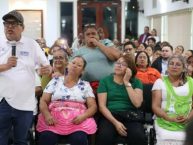
Each week hundreds of ‘mega health fairs’ are carried out in semi urban and rural areas, another way of bringing preventative health care to communities.
This was in stark contrast to the period of US-backed neo-liberal governments from 1990 to 2007 when health care for the impoverished majority meant that ‘public hospitals were places where you went to die…unless your family could afford to save you,’ according to Becca Renk, coordinator of the Casa Ben Linder in Managua.
Since 2007 the country’s health care system has been revolutionised to a family and community-based model with an emphasis on prevention. For example, in spite of not mandating lockdowns, Nicaragua had the lowest COVID death rate in the Americas. This was due largely to a comprehensive community education programme which involved over five million house visits, carried out largely by medical staff and community volunteers. Government spending on health care represents 21% of annual budgets. There are now 82 new or remodeled hospitals and a network of thousands of new or remodeled neighbourhood health centres and health posts, making Nicaragua’s the largest public health network in Central America. This includes clinics specialising in natural medicine, special needs, pain, mental health, and addiction.
Health promoters carry out door-to-door visits to eliminate mosquitoes, do contact tracing during epidemics, and co-ordinate vaccination campaigns. Thanks to their work, Nicaragua’s vaccination rate against childhood illness is up from 88% twenty years ago to 95% and protects against 18 illnesses instead of just 10 covered in 2006. Each week hundreds of ‘mega health fairs’ are carried out in semi urban and rural areas, another way of bringing preventative health care to communities.
Mobile health clinics set up in lorries confiscated from drug traffickers bring heath care to underserved rural areas. These clinics are typically staffed by nurses, doctors and dentists and have ultrasound facilities.
From preventative care in communities to advanced treatment in hospitals the quality of Nicaragua’s free health care is among the best in the region. Previously, one of the biggest killers of women was cervical cancer. This has decreased by 16% through early detection. In addition, almost 100% of girls aged 10-14 have been vaccinated against cervical cancer
A network of 182 ‘maternity wait homes’ (casas maternas) provide safe, secure places where women can go for up to two weeks before giving birth. More than 70,000 women annually use these services contributing to an 82.8% reduction in maternal mortality and a 63.17% reduction in neonatal mortality. There has also been a 24% reduction in premature births.
Specialised equipment and personnel in hospitals enable the provision of advanced treatment. In 2021, Nicaraguan doctors became the first in Central America to perform surgery on foetuses to correct life-threatening conditions like spina bifida before birth. By the end of 2025, 545 surgeries of this type had been performed free.
In 2024 Nicaragua was recognised by the Pan American Health Organization for its innovation in digital health. PAHO said, “Nicaragua stood out among 24 countries due to its leadership in working with the population, its ability to mobilise resources, general and specialized knowledge, the obstacles overcome, and the novelty of the strategy’s approach.”
Briefs
By Nan McCurdy
Construction of 590 Homes to Begin in Five Municipalities
The Government of Reconciliation and National Unity, through the Institute of Housing (INVUR), will launch five new “Nuevas Victorias” comprehensive housing development projects, under which 590 homes will be built in the municipalities of Tipitapa, Masaya, Chinandega, Jinotega, and Somoto. According to a press release, 120 homes will be built in Tipitapa, 120 in Masaya, 109 in Chinandega, 113 in Juigalpa, and 128 in Somoto over a 15-month period. These new comprehensive housing developments will be fully equipped with all necessary services: water, electricity, street lighting, a sanitation system, paved streets, sidewalks, traffic signs, an access gate, playgrounds, and a sports field for the recreation of the families living there, all within a safe, comfortable, and pleasant environment. (La Primerisima, 12 October 2026)
Foreign Ministry Sends Note to El Salvador
On October 8, Nicaragua’s Foreign Ministry sent a diplomatic note to the Foreign Ministry of El Salvador rejecting statements made on that same date by the Salvadoran Attorney General’s Office, “released through its official channels, in which reference is made to the alleged shipment of cocaine from Nicaraguan territory, by sea and bound for Guatemala, using El Salvador as a transit country.”
“In this regard,” the Nicaraguan note said, “the Government of the Republic of Nicaragua expresses its concern and rejects the statements made in these terms by a prosecutor who does not formally represent the State of El Salvador and who has made statements regarding another State based on facts of which he has no knowledge and without publicly providing verifiable information that would allow for an understanding of their basis.”
Nicaragua requested that El Salvador share through appropriate channels “the available information regarding the events in question and the background supporting the statement, including—to the extent permitted by applicable regulations—the relevant documentation.” This, the Nicaraguan note added, “will allow us to responsibly assess what has occurred and provide an appropriate response, with due legal and diplomatic rigor.”
In the note, Nicaragua reiterated its “firm commitment to preventing and combating drug trafficking and all forms of transnational organized crime” and said it remained “willing to cooperate with the States of the region, in accordance with the relevant mechanisms and procedures.” (La Primerísima, 8 October 2026) [Even 100% Noticias, an opposition media outlet, noted the unsubstantiated nature of the accusations, saying that “questions remain about the connection to Nicaragua. The Salvadoran Attorney General’s Office has not specified from which points along the Nicaraguan coast the boats departed, whether there are Nicaraguan citizens among those under investigation, or where the drugs originated before reaching the country.”]
Press Release on Tanker Attacked by Drone
In response to a flurry of news announcements, Nicaragua’s General Directorate of Water Transport issued a press release on October 12 to clarify that there was no registration data indicating that the tanker which was attacked by a drone near the Strait of Hormuz on October 11, had been registered with or flew the flag of the Nicaraguan maritime and port authority. The tanker named Petro Dolphin was attacked by a drone on October 11, 2026, while it was in the Sphar anchorage area, Oman, near the Strait of Hormuz. (La Primerisima, 12 October 2026)
[An article in Maritime-Executive states that “Petro Dolphin is a 4,000 dwt coastal product tanker built in 2004. It is UAE-owned and operated, and has no port state control inspection history, indicating a domestic operating pattern. The vessel’s Equasis record suggests that it is falsely flagged in Nicaragua.”]Women’s Police Stations Make 22,000 Door-to-Door Visits in a Week
The National Police presented the results of the Women’s Police Stations Prevention and Safety Plan for the period from October 1 to 7, 2026. The Safety Plan focused on protecting lives, raising community awareness, and apprehending perpetrators of crimes against women in the country’s 153 municipalities. Commissioner Karen Obando, from the National Police’s Joint Public Relations Office explained that during the week, 22,225 in-person door-to-door visits were conducted, reaching 31,725 women. In addition,130 meetings were held with the participation of 22,311 community members, along with discussions with 10,140 families, promoting the Safety Plan’s violence prevention booklets.
During the door-to-door visits, authorities received seven local reports (from Managua, León, Chinandega, Nueva Segovia, Siuna, and Bilwi) regarding crimes of assault, intimidation, sexual abuse, and rape. As a direct result of these operational actions the National Police arrested three individuals accused of these crimes in the departments of León, Nueva Segovia, and the North Caribbean Coast Autonomous Region (Siuna). (La Primerisima, 8 October 2026)
TELCOR Signs Agreement to Ensure a Safe Digital Environment for Children
As part of the working sessions of the Second Global Digital Forum 2026, the government, through the Nicaraguan Institute of Telecommunications and Postal Services (TELCOR), formalized its accession to the “Global Alliance for the Protection of Children in the Digital Space” on October 9. This initiative promotes multinational coordination and cooperation to establish safe virtual environments that ensure the comprehensive protection of children in the face of the challenges posed by emerging technologies. With this accession, Nicaragua reaffirms its diplomatic stance in favor of international cooperation based on mutual trust, solidarity, and unrestricted respect for the digital sovereignty of nations. (La Primerisima, 9 October 2026)
More than 2,000 Women Received Care at a Large-Scale Health Fair
In the department of Granada, 2,347 women received more than 4,000 medical consultations at the women’s health fair held on October 10. During the event, women received specialized care to facilitate early detection of breast and cervical cancer, as well as to identify potential complications during pregnancy and health issues in unborn babies. See photos: https://radiolaprimerisima.com/2026/10/11/mas-de-2-mil-granadinas-atendidas-en-mega-feria-de-salud/ (La Primerisima, 11 October 2026)
Children with Disabilities Create Educational Robotics Projects
The Sandinista government held the Inclusive Technology Expo at the Josefa Ortiz Téllez Girón School, an innovative event where students with disabilities who are integrated into mainstream schools demonstrated their talent by developing and programming educational robotics projects. Susana Rugama, director of Special Education at the Ministry of Education (MINED), explained that the use of adapted digital resources enhances learning potential, memory, language skills, and concentration in students with specific educational needs. She explained that the program has progressed through key phases: it began with software adaptations for students with autism and hearing or intellectual disabilities, continued with the creation of texts and video books in sign language, and is currently developing accessible digital books adapted for regular elementary schools. During the exhibition, students accompanied by their teachers and families presented functional prototypes such as robotic cars and a mechanical elephant using gears, sensors, and motors, demonstrating how accessible technology opens up new horizons for development and stimulates creativity without barriers. See photos: https://radiolaprimerisima.com/2026/10/13/ninos-con-discapacidad-crean-proyectos-de-robotica-educativa/ (La Primerisima, 13 October 2026)